A New Era with New Medication
11/05/25 12:01
The Copaxone Era has come to an end, and the box of remaining syringes will remain untouched until I find a home for the Sharps Waste. Not sure whether my GP will take it (without charging for it) if they do charge then I’ll take it on my next Walton Centre appointment and they will take it.
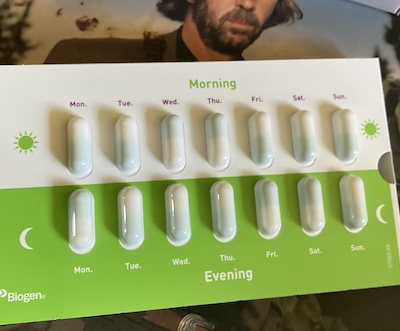
So this morning was the first time I took a dose of Tecfidera. They need to be taken with food, and that requires a change for me as I usually have just a coffee or two for breakfast. In future I may well just have Greek yoghurt and honey as my morning accompaniment to the first dimethyl fumarate capsule of the day. The medicine is taken as two doses, always with food and a minimum of four hours apart. In reality that will generally mean breakfast and evening meal. I’m not brilliant with tablets—and these are pretty big compared to any others I’ve had—but it is important that they are swallowed whole to properly deliver the dose. I’m gonna have to improve in swallowing them without coughing them out again, or damaging the coating if I don’t swallow them quickly. Twice a day forever will no doubt count as decent practice.
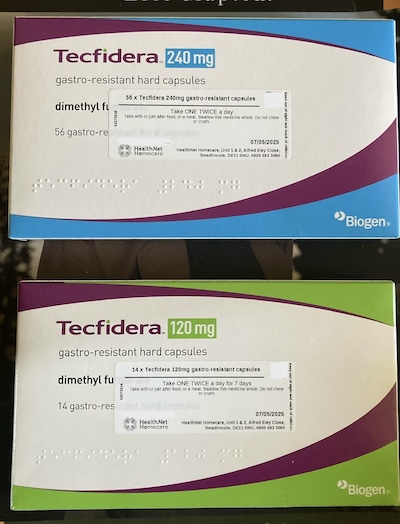
It is a week of half dose (120 mg) capsules before going on to the 240 mg dose. I haven’t opened that box, but I’m assuming (always dangerous) that the caps are the same size and not double.
I think I did get the flushing side effect a while after taking it. But my guts and beyond, which can commonly be impacted by side effects apparently, seemed unaffected. So that’s good. Will have to see how it is going forward. The booklet that comes with the drug has a notes page for keeping records and I should definitely use it for a while at least.
The medication was delivered in the afternoon. In the morning I went to the Walton Centre to meet a doctor who is undertaking a study of the effect of Tecfidera on livers (the NABS study). Apparently there is some evidence that it can positively impact on the liver and there is then some consideration being made about whether it can be used to treat patients with diseases of the liver.
I had to answer a load of questions on diet (including drink), lifestyle, and exercise. After that I was weighed, measured (height and waist), had bloods taken, and my liver was scanned (using FibroScan) . All this will provide the baseline data for the study. The doctor was actually a liver surgeon and not involved in MS. Going forward I’ll be getting scans and blood tests every three months (I need to go in every three months for the MS monitoring as well). Ideally they will undertake the tests on the same day so I wont need to go in twice.
I’m glad I volunteered for the study. More tests can only assist identifying any issues early doors for me, and more data for the study on the effects of the drug on the liver can only help others (or at least prove one way or another whether it is potentially significantly beneficial).
Incidentally the FibroScan showed my liver was in the normal range for a healthy liver with respect to fat and to stiffness. Now if I hadn’t volunteered then I wouldn’t know this. Already a benefit then. Let’s see what happens over the next three months.
So this morning was the first time I took a dose of Tecfidera. They need to be taken with food, and that requires a change for me as I usually have just a coffee or two for breakfast. In future I may well just have Greek yoghurt and honey as my morning accompaniment to the first dimethyl fumarate capsule of the day. The medicine is taken as two doses, always with food and a minimum of four hours apart. In reality that will generally mean breakfast and evening meal. I’m not brilliant with tablets—and these are pretty big compared to any others I’ve had—but it is important that they are swallowed whole to properly deliver the dose. I’m gonna have to improve in swallowing them without coughing them out again, or damaging the coating if I don’t swallow them quickly. Twice a day forever will no doubt count as decent practice.
It is a week of half dose (120 mg) capsules before going on to the 240 mg dose. I haven’t opened that box, but I’m assuming (always dangerous) that the caps are the same size and not double.
I think I did get the flushing side effect a while after taking it. But my guts and beyond, which can commonly be impacted by side effects apparently, seemed unaffected. So that’s good. Will have to see how it is going forward. The booklet that comes with the drug has a notes page for keeping records and I should definitely use it for a while at least.
The medication was delivered in the afternoon. In the morning I went to the Walton Centre to meet a doctor who is undertaking a study of the effect of Tecfidera on livers (the NABS study). Apparently there is some evidence that it can positively impact on the liver and there is then some consideration being made about whether it can be used to treat patients with diseases of the liver.
I had to answer a load of questions on diet (including drink), lifestyle, and exercise. After that I was weighed, measured (height and waist), had bloods taken, and my liver was scanned (using FibroScan) . All this will provide the baseline data for the study. The doctor was actually a liver surgeon and not involved in MS. Going forward I’ll be getting scans and blood tests every three months (I need to go in every three months for the MS monitoring as well). Ideally they will undertake the tests on the same day so I wont need to go in twice.
I’m glad I volunteered for the study. More tests can only assist identifying any issues early doors for me, and more data for the study on the effects of the drug on the liver can only help others (or at least prove one way or another whether it is potentially significantly beneficial).
Incidentally the FibroScan showed my liver was in the normal range for a healthy liver with respect to fat and to stiffness. Now if I hadn’t volunteered then I wouldn’t know this. Already a benefit then. Let’s see what happens over the next three months.
Comments
Volunteered for Something
30/04/25 08:14
Well I hadn’t heard from anyone about the proposal of the change of medication from the Copaxone syringes to the Tecfidera tablets, but it was always going to take quiet a while for all the discussions and approvals getting in place. But I got a call asking if I’d be interested in joining a survey program for a study being undertaken at the Walton Centre, which would involve me getting various additional blood tests and scans. Of course I said yes. I’m not sure yet what I’ve agreed to, but if me getting tested helps in increasing the understanding of the damn disease and its treatments then it’s got to be a good thing, ain’t it?
At the end of the phonecall I asked if the Tecfidera approval was progressing. Of course it turned out that’s why they’ve asked me to join the study (which they kept saying was voluntary and I didn’t need to do), it’s because the medication change has indeed been confirmed and the study is about the drug. I'm now getting the drugs delivered in a week too, so i can start on it straight after my baseline tests are done. Fingers crossed it'll be a help and not give me too many side effects (or at least not bad ones).
Onwards and Upwards.
At the end of the phonecall I asked if the Tecfidera approval was progressing. Of course it turned out that’s why they’ve asked me to join the study (which they kept saying was voluntary and I didn’t need to do), it’s because the medication change has indeed been confirmed and the study is about the drug. I'm now getting the drugs delivered in a week too, so i can start on it straight after my baseline tests are done. Fingers crossed it'll be a help and not give me too many side effects (or at least not bad ones).
Onwards and Upwards.
Meditation on Medication
14/03/25 16:30
After well over a year between Walton Centre visits I’ve just had two visits within four weeks. During the last one there was some talk about taking a drug (Aubagio) to replace the Copaxone I’ve been on—in light of a recent relapse. When I took a phone call the other week the talk was about a different drug; Tecfidera (dimethyl fumarate). I assume that the addition of a different possibility was after the nurse had spoken to the consultant. The centre sent me a detailed guide to the drug to help my considerations.
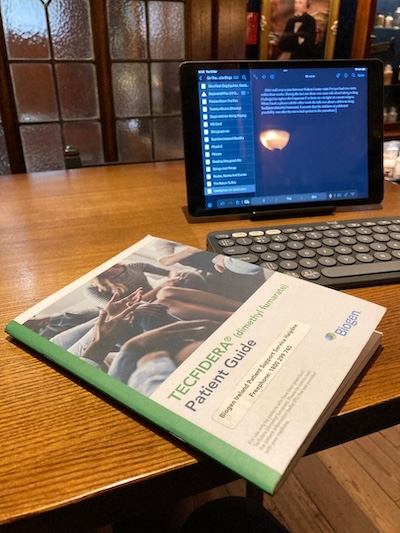
There are a quite a few things to consider with the medication (Tecfidera). There are plenty of possible side effects some more common, some quite serious. And the way that the drug works and can impact on people means that there will need to be quarterly blood tests in order to identify potentially significant issues. The more common ones (c.1 in 10) are gastric ones, flushing, and hair loss is listed too. The more significant ones include PML (the mighty mouthful of ‘progressive multifocal leukoencephalopathy), which is where the blood tests come in. It’s handy living near to the Walton Centre as I should just be able to pop in there every 3 months and get the samples taken without messing about with booking appointments (often a more painful experience than the actual needle in the arm).
Interestingly they know that the drug works but they don’t understand completely why. Like Viagra the drug was actually designed for something else (psoriasis) and subsequently found to be useful in the treatment of MS.
Anyways all the side effects are possibilities not guaranteed effects, in any case maybe I’d look good red faced and bald. The main thing is the drug will likely do a better job than Copaxone and—importantly—actually treat the MS to some extent, and not just reduce the risk of a relapse, so I’ve decided to go for it. It’s a no brainer really.
First up was some blood sampling—taken today whilst there—to see if my body is up to it and also to set a baseline. There may be an MRI (but probably not).
It’ll probably be a month or so until I get on it. First the bloods results, then various toing and froing between people for approving and issuing the prescription then getting it ordered (the same home delivery company a those that deliver the Copaxone). The first few months on the drug may be interesting, but even if there are some negative impacts hopefully things would settle down after that. Fingers crossed for everything.
There are a quite a few things to consider with the medication (Tecfidera). There are plenty of possible side effects some more common, some quite serious. And the way that the drug works and can impact on people means that there will need to be quarterly blood tests in order to identify potentially significant issues. The more common ones (c.1 in 10) are gastric ones, flushing, and hair loss is listed too. The more significant ones include PML (the mighty mouthful of ‘progressive multifocal leukoencephalopathy), which is where the blood tests come in. It’s handy living near to the Walton Centre as I should just be able to pop in there every 3 months and get the samples taken without messing about with booking appointments (often a more painful experience than the actual needle in the arm).
Interestingly they know that the drug works but they don’t understand completely why. Like Viagra the drug was actually designed for something else (psoriasis) and subsequently found to be useful in the treatment of MS.
Anyways all the side effects are possibilities not guaranteed effects, in any case maybe I’d look good red faced and bald. The main thing is the drug will likely do a better job than Copaxone and—importantly—actually treat the MS to some extent, and not just reduce the risk of a relapse, so I’ve decided to go for it. It’s a no brainer really.
First up was some blood sampling—taken today whilst there—to see if my body is up to it and also to set a baseline. There may be an MRI (but probably not).
It’ll probably be a month or so until I get on it. First the bloods results, then various toing and froing between people for approving and issuing the prescription then getting it ordered (the same home delivery company a those that deliver the Copaxone). The first few months on the drug may be interesting, but even if there are some negative impacts hopefully things would settle down after that. Fingers crossed for everything.
MS Stress
23/02/25 14:06
Went to the wonderful Walton Centre for a meeting with a couple of the MS Nurses a week or so ago. All in all it was an interesting appointment.
My MS has been steady for the last few years, but over the last few weeks I have been suffering from my first relapse since my initial two relapses, which was back when I was diagnosed.
For those of you who don’t know, a ‘relapse’ is not (as it sounds) a return to any earlier symptoms but relates to something different—a symptom that you haven’t had before. The current relapse is an almost total numbness of the lower torso from above the belly button height and all around from back to front. It is also partially down my left leg. The attack of course is to my nerves (the myelin coating) on the spine or in the brain (or both) in specific areas. In this case it appears to be nerves near the base of the spine.
It’s weird not feeling the syringe with the Copaxone going in to the belly. Whilst not feeling the injection sounds quite nice, it’s not exactly, is it? Not feeling your torso is disorientating at the moment and has other issues relating to it. I am hopeful, as in the previous attacks, that most of the feeling will come back over the next few weeks; but the return of the RRMS has left me pretty stressed to be honest.
One thing that came up in discussion was the issue I have with fatigue when standing up for over an hour or so (eg at a gig). It created much hilarity when the nurse suggested that one of the best ways to reduce the fatigue was to piss myself. I was quite taken aback by this suggestion until after some requests for repetition I found it was an accent issue and she’d actually meant ‘pace’. Much better idea I reckon.
They’ve written a letter for me which I hope to use to apply for an Access Card to help my when attending events (with better access to toilets and seats etc). I’d had to put off going to the Lottery Winners gig at Manchester Academy between Xmas and New Year because I was too worried that I wouldn’t find a place to sit (I was using a walking stick at the time). I was gutted at missing it but it was the correct decision at the time. We shall see whether I, a) get one and b) if it’s worth getting.
Another discussion was around possibly changing my medication from the three times a week Copaxone (glatiramer acetate) injections to daily tablets (Aubagio—terifluomide). When I first went for the injections it was partly due to the worry about purposely lowering your white blood cell count and also requiring regularly blood testing (not required with the Copaxone treatment). Given I am currently attacking myself again lowering the White Blood Cells doesn’t seem as bad an idea at all. The nurse is to call me back over the next few weeks and I am currently minded to opt for the change to Aubagio after the next batch of Copaxone is completed. We shall see.
Watch this space. In the meantime though I need to take some deep, deep breaths and try to stress less in general.
My MS has been steady for the last few years, but over the last few weeks I have been suffering from my first relapse since my initial two relapses, which was back when I was diagnosed.
For those of you who don’t know, a ‘relapse’ is not (as it sounds) a return to any earlier symptoms but relates to something different—a symptom that you haven’t had before. The current relapse is an almost total numbness of the lower torso from above the belly button height and all around from back to front. It is also partially down my left leg. The attack of course is to my nerves (the myelin coating) on the spine or in the brain (or both) in specific areas. In this case it appears to be nerves near the base of the spine.
It’s weird not feeling the syringe with the Copaxone going in to the belly. Whilst not feeling the injection sounds quite nice, it’s not exactly, is it? Not feeling your torso is disorientating at the moment and has other issues relating to it. I am hopeful, as in the previous attacks, that most of the feeling will come back over the next few weeks; but the return of the RRMS has left me pretty stressed to be honest.
One thing that came up in discussion was the issue I have with fatigue when standing up for over an hour or so (eg at a gig). It created much hilarity when the nurse suggested that one of the best ways to reduce the fatigue was to piss myself. I was quite taken aback by this suggestion until after some requests for repetition I found it was an accent issue and she’d actually meant ‘pace’. Much better idea I reckon.
They’ve written a letter for me which I hope to use to apply for an Access Card to help my when attending events (with better access to toilets and seats etc). I’d had to put off going to the Lottery Winners gig at Manchester Academy between Xmas and New Year because I was too worried that I wouldn’t find a place to sit (I was using a walking stick at the time). I was gutted at missing it but it was the correct decision at the time. We shall see whether I, a) get one and b) if it’s worth getting.
Another discussion was around possibly changing my medication from the three times a week Copaxone (glatiramer acetate) injections to daily tablets (Aubagio—terifluomide). When I first went for the injections it was partly due to the worry about purposely lowering your white blood cell count and also requiring regularly blood testing (not required with the Copaxone treatment). Given I am currently attacking myself again lowering the White Blood Cells doesn’t seem as bad an idea at all. The nurse is to call me back over the next few weeks and I am currently minded to opt for the change to Aubagio after the next batch of Copaxone is completed. We shall see.
Watch this space. In the meantime though I need to take some deep, deep breaths and try to stress less in general.
Physio 2
19/11/24 00:29
Went to physio for just the second time last week. It was a different practitioner than previously, and my next appointment is in just a few weeks. I’ve been given some different exercises to do—and this time their app was working which actually showed the exercises; and could be printed off and emailed to me. Definitely going to do them more regularly now and see what a difference it will make to my legs. It seems I really need to work on straightening the legs fully and that will largely be assisted through stretching the hamstrings out. Just straightening the legs I can feel the hamstrings do their stuff. Handily a few of the exercises can be done without the requirement of any equipment other than steps or a chair—and don’t need the resistance band. So I’ve no excuse not to do them at any point in the day that I can.
I dare say it is important to do it methodically rather than ad hoc though lest they won't get done properly. We’ll see how it goes this month anyway. Onwards and Upwards (with straight legs).
I dare say it is important to do it methodically rather than ad hoc though lest they won't get done properly. We’ll see how it goes this month anyway. Onwards and Upwards (with straight legs).